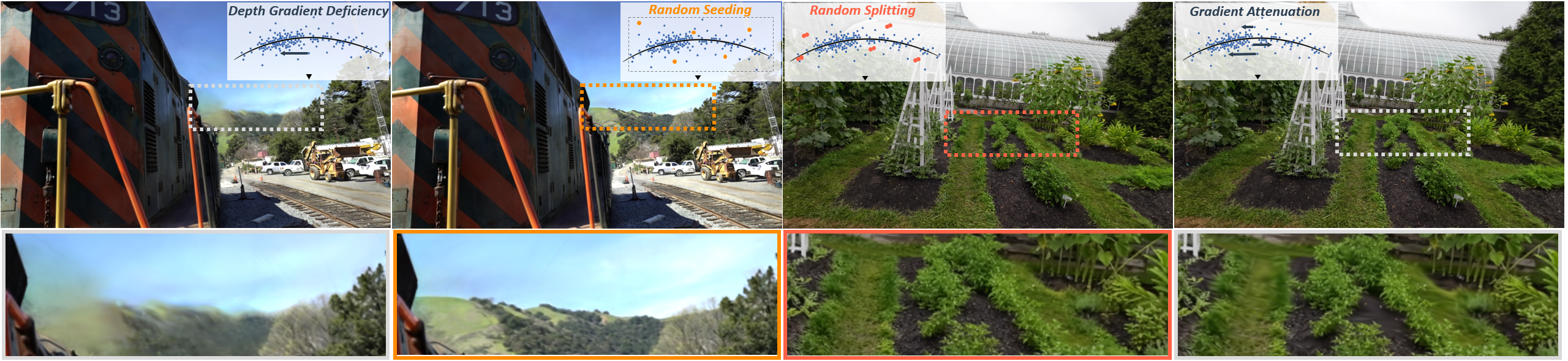
The Blur Trap
What is the Blur Trap?
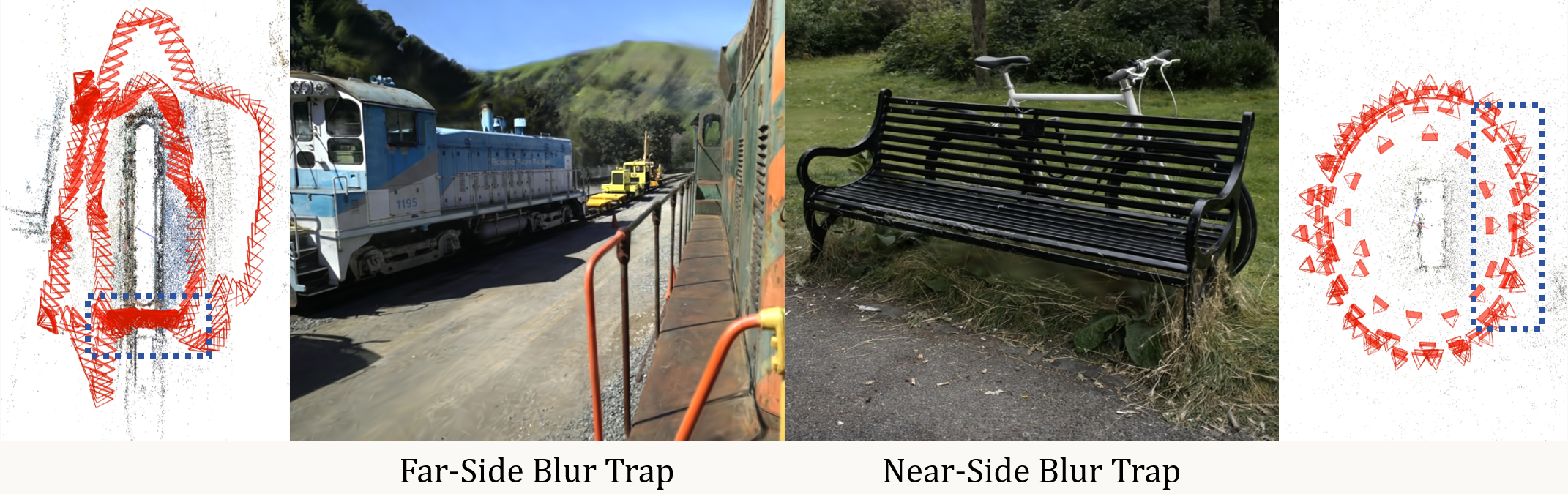
In 3DGS reconstructions, certain regions remain persistently blurry despite sufficient training views. This is not random noise — it appears consistently in two kinds of regions: distant content and occluded near-field regions. The persistence of these artifacts under abundant supervision indicates that the cause is not insufficient data but something rooted in the optimization process itself. We refer to this systematic failure as the Blur Trap.
⛰️
Far-Side Blur Trap
Arises in distant regions. Gaussians primitives stall at suboptimal depths with no corrective signal, leaving the rendered far field persistently blurry.
🌿
Near-Side Blur Trap
Arises in occluded foreground regions. Densification is suppressed, starving these regions of primitives and leaving the rendered near field persistently blurry.
Why does Blur Trap form?
We trace the issue back to the position gradients that drive 3DGS optimization.
The diagnosis begins with one empirical fact,
which then splits into two distinct gradient deficiencies —
one of direction and one of magnitude.
💡 Key Insight The 2D position gradient dominates the 3D position update.
The 3D position update of each Gaussian is composed of three branches, corresponding to the 2D projected position, the 2D covariance, and the spherical harmonic coefficients.
Empirically, the 2D position component dominates the other two by two to three orders of magnitude throughout training.
The position update is therefore effectively governed by 2D position gradient alone.
The two analyses below examine this single derivative term along two axes — its direction and its magnitude ↓
📐 Direction Orthogonality
We prove that the 3D position update derived from this dominant 2D gradient is strictly orthogonal to the viewing ray. The optimizer can only move primitives within the image plane and never along the depth direction. No depth-directed optimization signal exists to drive distant Gaussians to their correct depth — this is the root cause of the Far-Side Blur Trap.
📉 Magnitude Attenuation
The same 2D gradient also serves as the densification criterion.
In the $\alpha$-blending pipeline, multiple Gaussians at different depths jointly render the same pixel color, diluting the gradient contribution of each individual occluded primitive.
As a result, later-ranked Gaussians receive transmittance-weighted gradients whose magnitude decays rapidly, and the densification trigger is systematically suppressed before it can fire — this is the root cause of the Near-Side Blur Trap.
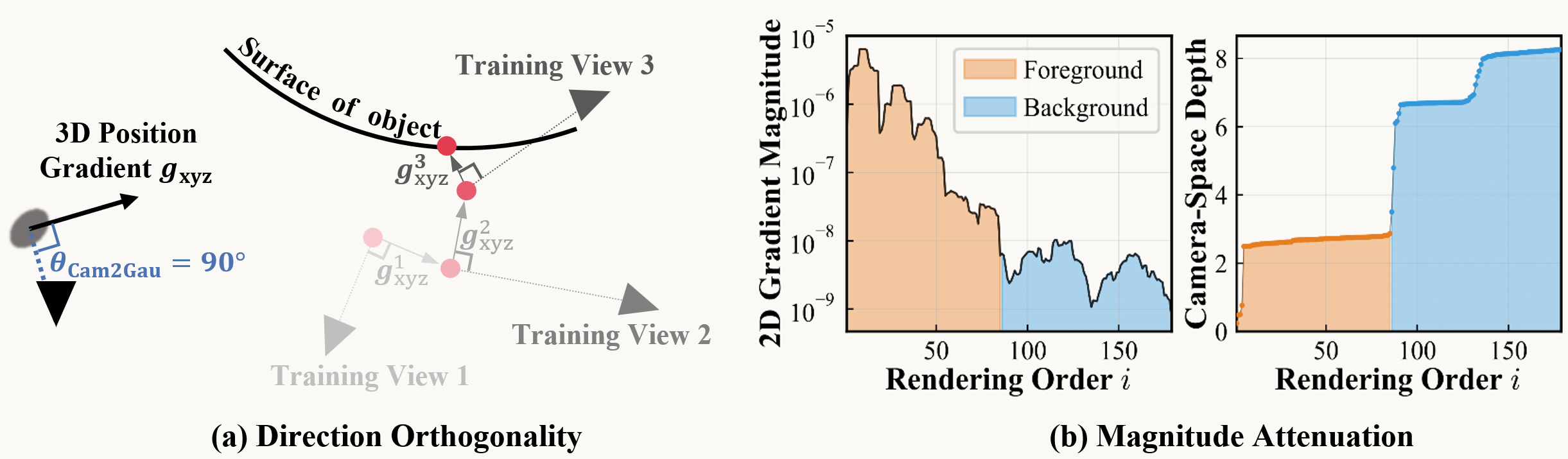
The Blur Trap stems from two gradient deficiencies.
(a) Direction orthogonality: the dominant gradient is orthogonal to the viewing ray, preventing depth-directed optimization — the root cause of the Far-Side Blur Trap.
(b) Magnitude attenuation: multiple Gaussians at different depths jointly render the same pixel via $\alpha$-blending, diluting the gradient magnitude of each occluded primitive and suppressing densification — the root cause of the Near-Side Blur Trap.